
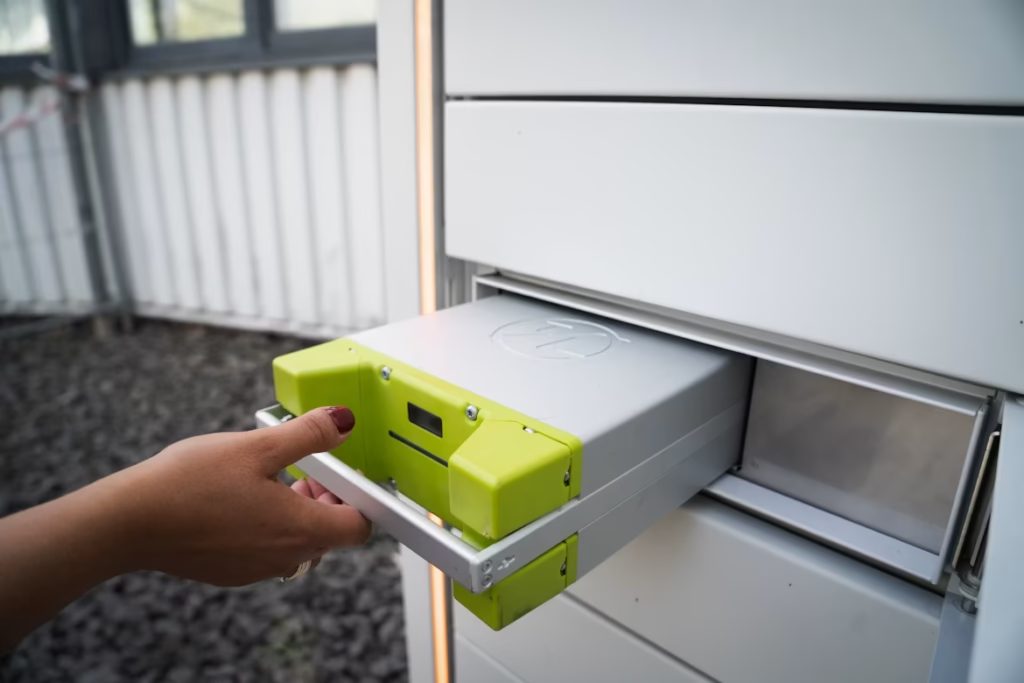
Home Battery Storage Systems: Complete 2026 Guide
Introduction
Home battery storage systems have moved from niche technology to mainstream necessity for American homeowners. With average US residential electricity rates hitting $0.17 per kWh in 2026 — up nearly 22% from 2022 — and extreme weather events knocking out power for millions of households each year, the question is no longer whether to invest in storage, but which system makes the most financial sense for your home. Home battery storage systems let you capture energy from solar panels or cheap off-peak grid electricity, then deploy it when prices spike or the grid goes dark. In this comprehensive guide, we break down real costs, real savings, the 30% federal tax credit still available under the Inflation Reduction Act, top-rated products, and state rebate programs — so you can make a confident, data-backed decision today.
How Do Home Battery Storage Systems Actually Work?
A home battery storage system is essentially a large rechargeable lithium-ion (or lithium iron phosphate) battery bank paired with an inverter and an energy management system (EMS). Here is the basic cycle:
- Charge phase: The battery charges from rooftop solar panels, a wind turbine, or directly from the utility grid during low-rate off-peak hours (typically midnight–6 a.m.).
- Monitor phase: The EMS continuously tracks grid prices, weather forecasts, your home’s real-time consumption, and battery state of charge.
- Discharge phase: When solar production is low, grid prices are high, or the utility grid fails, the battery discharges to power your home automatically.
Modern systems communicate with your utility through smart meters and even participate in virtual power plant (VPP) programs, where your battery earns bill credits by feeding electricity back to the grid during demand peaks. According to the Department of Energy, VPP participants in 2025 earned an average of $150–$400 per year in utility bill credits without any additional hardware.
Most residential systems use one of two battery chemistries:
- Lithium-ion NMC (Nickel Manganese Cobalt): Higher energy density, lighter weight, slightly higher cost. Common in Tesla Powerwall 3.
- Lithium Iron Phosphate (LFP): Longer cycle life (6,000–10,000 cycles vs. 3,000–4,000), safer thermal profile, slightly bulkier. Common in Enphase IQ Battery 10T and Franklin Electric aPower.
What Are the Best Home Battery Storage Systems Available?
The residential battery market has matured significantly. Below is a comparison of the leading systems certified for US installation as of 2026.
| System | Usable Capacity | Peak Power | Chemistry | Warranty | Installed Cost (est.) |
|---|---|---|---|---|---|
| Tesla Powerwall 3 | 13.5 kWh | 11.5 kW | NMC | 10 years / 70% capacity | $12,000–$14,500 |
| Enphase IQ Battery 10T | 10.08 kWh | 3.84 kW | LFP | 15 years / 80% capacity | $11,500–$14,000 |
| Franklin aPower 2 | 13.6 kWh | 10 kW | LFP | 12 years / 80% capacity | $11,000–$13,500 |
| SolarEdge Home Battery | 9.7 kWh | 5 kW | LFP | 10 years / 70% capacity | $10,500–$13,000 |
| Generac PWRcell M6 | 18 kWh | 9 kW | NMC | 10 years / 70% capacity | $18,000–$23,000 |
For most American households averaging 29 kWh per day of consumption (EIA, 2026), a single 13–14 kWh battery covers roughly one-half of a day’s needs — enough to power critical loads (refrigerator, lights, internet, phone charging, a medical device) through a typical overnight outage. Two batteries in parallel cover full-home backup for 18–24 hours.
How Much Do Home Battery Storage Systems Cost — and What Is the ROI?
Cost is the first question every homeowner asks. The honest answer depends on your utility rate structure, solar ownership, local incentives, and how often your area experiences outages. Let’s break it down with real numbers.
| Scenario | Gross System Cost | 30% ITC Credit | Net Cost | Annual Savings | Payback Period |
|---|---|---|---|---|---|
| Battery only, time-of-use rate shifting | $13,000 | $3,900 | $9,100 | $480–$720 | 12–19 years |
| Battery + solar (6 kW system) | $31,000 | $9,300 | $21,700 | $1,800–$2,600 | 8–12 years |
| Battery + solar + VPP enrollment | $31,000 | $9,300 | $21,700 | $2,100–$3,100 | 7–10 years |
| Two batteries + solar, CA SGIP rebate | $44,000 | $13,200 | $21,600* | $2,400–$3,500 | 6–9 years |
*CA SGIP rebate of approximately $9,200 additional applied. See state rebates section below.
The financial case is strongest when you combine the federal Investment Tax Credit with time-of-use (TOU) rate arbitrage and solar self-consumption. Homeowners on TOU rates in California, New York, Texas, and Arizona consistently see the fastest payback periods — often under 8 years — because peak-to-off-peak rate spreads can exceed $0.18–$0.35 per kWh.
What Federal Tax Credits Apply to Home Battery Storage Systems?
The single biggest financial lever for American homeowners in 2026 is the Section 25D Residential Clean Energy Credit, maintained at 30% of total installed system cost through December 31, 2032 under the Inflation Reduction Act. Here is exactly what you need to know:
- Credit rate: 30% of total installed cost (equipment + labor + permits).
- Standalone eligibility: Since January 1, 2023, battery storage systems qualify for the 30% credit even without solar panels, as long as the battery has a minimum storage capacity of 3 kWh.
- No income cap: Unlike the EV credit, there is no adjusted gross income limit for the Section 25D battery credit.
- Carryforward: If your tax liability in the year of installation is less than the credit amount, you can carry the unused portion forward to future tax years indefinitely through 2032.
- How to claim: File IRS Form 5695 with your federal tax return for the year installation is complete.
| Installed System Cost | 30% ITC Credit Value | Your Net Cost | IRS Form |
|---|---|---|---|
| $10,500 | $3,150 | $7,350 | Form 5695 |
| $13,000 | $3,900 | $9,100 | Form 5695 |
| $18,000 | $5,400 | $12,600 | Form 5695 |
| $31,000 (solar + battery) | $9,300 | $21,700 | Form 5695 |
Pro tip: Schedule your installation to complete before December 31 of a tax year in which you have sufficient federal tax liability to absorb the full credit. Consult a CPA or enrolled agent familiar with residential energy tax credits before making installation decisions.
Should You Pair Home Battery Storage With Solar Panels?
Pairing a home battery storage system with a rooftop solar array is widely considered the gold standard setup for American homeowners in 2026 — and for good reason. Here is why the combination outperforms either technology alone:
1. Self-consumption optimization: A typical 6 kW solar system produces about 24–28 kWh on a sunny day. Without storage, excess midday energy is exported to the grid, often at low net-metering rates. With a battery, that energy is stored and used during evening peak hours when grid rates are highest.
2. Resilience: Solar-only systems are required by utility interconnection standards to shut down automatically during a grid outage (to protect line workers). A battery with an automatic transfer switch creates an islanded microgrid, allowing your solar panels to keep charging your home even when the grid is down.
3. Net Billing vs. Net Metering transition: Many US states — including California (NEM 3.0), Nevada, and Arizona — have shifted from retail-rate net metering to lower net billing compensation rates. The battery arbitrage advantage has consequently grown significantly. California NEM 3.0 export rates average just $0.05–$0.08 per kWh, while self-consumed solar avoids paying $0.30+ per kWh grid rates during peak hours.
Bottom line: If you already have solar or plan to install it, adding battery storage is almost universally financially beneficial in 2026’s rate environment. If you are battery-only (no solar), the payback is longer but still achievable in high-rate states.
What Does Installation of a Home Battery Storage System Involve?
Understanding the installation process helps you ask the right questions when getting quotes and avoids costly surprises.
Step 1: Site Assessment
A certified installer evaluates your electrical panel (minimum 200-amp service is typically required), wall space for mounting, and internet connectivity for the battery management system. Older homes with 100-amp panels may need a panel upgrade, adding $1,500–$3,500 to the total project cost.
Step 2: Permitting
All residential battery installations require a building permit and electrical inspection. Permitting timelines range from 1–3 weeks in most jurisdictions. Your installer typically handles permit applications as part of the contract.
Step 3: Physical Installation
The battery unit mounts on an interior or exterior wall (rated for outdoor use if exterior). The inverter connects to your main panel or a dedicated sub-panel. Installation labor typically takes 4–8 hours for a single unit, one full day for a two-unit system.
Step 4: Utility Interconnection
If your battery will export energy to the grid or participate in VPP programs, your utility must approve an interconnection agreement. This can add 2–8 weeks to your timeline.
Step 5: Commissioning
Your installer configures the energy management software, sets your charge/discharge schedules, and connects the monitoring app. Most systems are fully operational within 30–60 days from contract signing.
Installer tip: Always hire a NABCEP-certified installer or a licensed electrician with documented battery storage experience. Verify they pull permits — any contractor suggesting you skip permits to save money is a red flag.
Can Home Battery Storage Systems Keep Your Lights On During Grid Outages?
This is the most emotionally compelling reason most homeowners cite for purchasing a battery system — and the answer is yes, with important caveats.
The key variable is how much of your home you want to back up and for how long. There are two backup configurations:
Partial home backup (most common, lower cost): A dedicated critical loads panel powers your refrigerator, a few lights, internet router, phone chargers, a medical device, and perhaps a well pump. A 13.5 kWh battery can typically power these loads for 12–24 hours.
Whole-home backup: Powers your entire home including HVAC. Requires multiple battery units (usually 27+ kWh) and careful load management. Two Tesla Powerwall 3 units can power an average 2,000 sq ft home for 8–18 hours depending on HVAC usage and season.
When paired with solar, your battery recharges every sunny day, making outage duration essentially unlimited as long as the sun shines. This is particularly valuable in hurricane-prone states like Florida and Texas, where outages can last 5–10 days following major storms.
According to ENERGY STAR data from 2025, homes with battery + solar backup systems experienced zero reported food spoilage or medical device interruptions during outages lasting less than 72 hours in surveyed regions — a remarkable resilience outcome.
Which State Rebate Programs Help Pay for Home Battery Storage?
Beyond the 30% federal tax credit, a patchwork of state rebates, utility incentives, and PACE financing programs can dramatically reduce your out-of-pocket cost. Here are the most valuable active programs as of 2026:
California — Self-Generation Incentive Program (SGIP): Offers $0.25–$0.85 per watt-hour of installed capacity depending on income tier and equity status. A 13.5 kWh battery qualifies for a base rebate of approximately $3,375 at the standard rate, and up to $11,475 for low-income households. Apply through your California IOU (PG&E, SCE, or SDG&E).
New York — NY-Sun Incentive Program + ConEd Battery Storage: NY-Sun provides $250 per kWh of battery capacity for residential systems co-installed with solar. ConEd customers in New York City may qualify for an additional $350 per kWh incentive through the ConEd Clean Virtual Power Plant program.
Massachusetts — SMART Program + MassSave: Battery storage co-installed with solar earns an adder to the SMART solar tariff. MassSave also offers 0% interest financing for up to $25,000 for energy efficiency and storage upgrades.
Texas — Oncor / CPS Energy Rebates: Oncor offers a $2,500 flat rebate for qualifying residential battery systems (minimum 7.5 kWh). CPS Energy in San Antonio offers $500–$1,000 rebates depending on system size and enrollment in their demand response program.
Maryland — CleanEnergy Rebate + EmPOWER Maryland: Maryland provides a $1,000 state income tax credit for residential energy storage systems, stackable with the federal ITC. EmPOWER Maryland utilities offer additional $200–$500 rebates.
Arizona, Nevada, Colorado, Hawaii: Multiple utilities in these states run active battery rebate programs ranging from $500–$3,000. Check the DSIRE database (dsireusa.org) for the most current program details in your specific utility territory.
Ready to Find Out What a Home Battery Storage System Would Cost You?
Use our free Aizexia Savings Calculator to get a personalized estimate based on your ZIP code, utility rate, and home size — including your exact 30% federal tax credit and available state rebates.
Frequently Asked Questions About Home Battery Storage Systems
Do home battery storage systems qualify for the 30% federal tax credit if I don’t have solar panels?
Yes. Since January 1, 2023, standalone home battery storage systems qualify for the full 30% Section 25D Residential Clean Energy Credit without requiring a solar installation. The only requirement is that the battery must have a rated capacity of at least 3 kWh. You claim the credit using IRS Form 5695 when you file your federal tax return for the year the installation is completed. The 30% rate is locked in through December 31, 2032.
How long do home battery storage systems last, and what happens when they need replacement?
Most residential lithium battery systems carry a 10–15 year manufacturer warranty guaranteeing at least 70–80% of original capacity at end of warranty. LFP (lithium iron phosphate) batteries typically last longer — 15–20 years with daily cycling — due to their superior cycle stability. When a battery reaches end of life, the main components (battery modules) can often be replaced without changing the inverter or wiring. Replacement module costs have fallen roughly 40% since 2022 and are projected to continue declining. Most manufacturers offer recycling programs for end-of-life battery packs in compliance with EPA guidelines.
What is the minimum battery capacity I need for whole-home backup power?
For meaningful whole-home backup including HVAC, the Department of Energy recommends a minimum of 20–27 kWh of usable storage capacity. The average American home uses approximately 29 kWh per day, but actual backup duration depends heavily on which appliances run. A 27 kWh system (two Tesla Powerwall 3 units, for example) can realistically power an average home for 18–24 hours with moderate HVAC use. For extended outages beyond 24 hours without solar recharging, consider 40 kWh or more of capacity or pair your battery with a propane or natural gas generator as a hybrid backup system.
Can I install a home battery storage system myself to save money?
DIY installation of home battery storage systems is strongly discouraged and may void both the manufacturer warranty and your homeowner’s insurance. More critically, it could disqualify you from the federal 30% tax credit, which IRS guidance requires be for costs paid to a qualified installer. Residential battery storage involves high-voltage DC and AC electrical work that requires a licensed electrician in all 50 states. The installation also requires a permitted electrical inspection. Always use a licensed, insured installer — preferably one with NABCEP certification or manufacturer-specific training credentials.
Will a home battery storage system increase my home’s resale value?
Yes, and the evidence is growing. A 2025 Lawrence Berkeley National Laboratory study found that homes with solar-plus-storage systems sold for a premium of approximately $10,000–$18,000 above comparable homes without energy systems in California, Arizona, and New York markets. Battery storage alone (without solar) added an estimated $4,000–$8,000 in value in high-outage-risk markets like Florida and Texas. As utility rates rise and grid reliability concerns grow, battery storage is increasingly viewed by appraisers as a value-adding permanent fixture, similar to a central AC system or updated kitchen appliances.
Your 2026 Home Battery Storage Action Checklist
You now have the complete picture. Home battery storage systems represent one of the most financially and practically sound investments an American homeowner can make in 2026 — combining significant federal tax incentives, rising electricity rates that reward storage arbitrage, and genuine resilience against an increasingly unreliable grid. Here is your step-by-step action plan:
✅ Your Home Battery Storage Checklist
- ☐ Check your current electricity rate plan — are you on time-of-use (TOU) rates? If not, ask your utility to switch. TOU rates maximize battery savings.
- ☐ Estimate your daily energy consumption — review 12 months of utility bills or use your utility’s online energy dashboard. Target: identify your peak usage hours.
- ☐ Determine your backup priorities — whole-home backup or critical loads only? This drives the kWh capacity you need.